Wednesday, June 24, 2020

Artist of the Month for June: Derik Hefner

This month I had the pleasure to interview Derik Hefner. Soon as I saw some of his work I knew I had encountered a kindred spirit. I am grateful he gave me this opportunity to answer some questions about his inspirations, his projects and being involved locally with the Artistic Community.


Looking at your work, especially the graphic novel you are working on, you obviously are a fan of the medium. What comic book artists inspired you and what writers fired your imagination?


The first artist I could recognize by style alone was John Byrne. I was 6 when the first issue of his Superman series came out. I was slightly confused at the time as to how it could be Superman’s first issue, but Byrne’s art was so distinct, his characters had mass and substance and form, and his backgrounds were full of gritty detail. And Terry Austin’s inks brought out all of that perfectly. Classic X-Men was coming out then too, so Byrne had a big presence in my early formative years, right when I was really getting sucked into comics in a big way. Other influences span the gamut: Will Eisner, Möebius, Bill Sienkiewicz, Chris Bachalo, Frank Miller, Paul Pope, Becky Cloonan, Sean Gordon Murphy, Gabriel Bá, Fabio Moon, Jamie Hewlett, Jordi Bernét, Mike Allred... I could go on and on with the artists I’ve picked up this or that from. Every artist’s style is a sort of Frankenstein’s Monster in that way. But looking at my work now, I can see that Byrne is the standard from which I’ve deviated. All the weirder influences just dress up and distort that Byrne skeleton, which is baked in.

John Byrne

As for writers, in comics, Chris Claremont was a huge influence. Over his decades-spanning X-Men run, he put you inside the heads of such a large cast, bouncing back and forth between thought bubbles and third-person narration in a way that you rarely see anymore. He provided an interesting lens through which to view the world. A community of people who would otherwise be loners, misunderstood and reviled by the world in spite of (or because of?) the fact that their cause is right and just. And taking the brunt of all that negative energy and giving back something positive instead. That resonates as loudly now as it did then.

Other writing influences, both within comics and elsewhere, is another long list (and I know I’m going to leave a lot out someone that I’ll regret not mentioning later), but immediately springing to mind are Grant Morrison, Brian K. Vaughan, James Robinson, Alan Moore, Ed Brubaker, Matt Fraction, Rick Remender, Jason Aaron. Early Vertigo comics are a high point of what comics can be, and I revisit those often. Outside of comics my reading interests are varied, but with fiction I tend to gravitate towards magic realism. Which is probably a testament to the comics influence, since when you think about it, virtually all comics could be considered magic realism. Kurt Vonnegut, Tom Robbins, Neil Gaiman, Chuck Palahniuk, Etgar Keret, Haruki Murakami. I’ve been singing the praises of China Miéville for several years now. Jim Thompson, a fellow Okie, is another favorite. Hunting down his books has been an ongoing project.


Derik Hefner


When I see your work I am reminded of Farel Dalrymple and Troy Nixey who worked on Mike Mignola's Jenny Finn. Also your panel layouts and camera angles look very professional. Do you do story boards before committing to a layout?

Jenny Finn
That’s very flattering! I wouldn’t point to either of them as direct influences, but it’s always interesting to hear what others see that I don’t. Someone recently compared my work to that of Brendan McCarthy, whose name I was more familiar with than his work. That led to me checking out his collaborations with writer Peter Milligan, and damned if I didn’t see it. If I was on the outside looking in, I’d think he was one of my biggest direct influences, yet I’d had almost no exposure to his work (outside of his covers, which were mostly painted). It’s a great experience, coming across kindred artists like that, arriving at the same place from different routes. It’s like when you make a new friend that you feel like you’ve known forever, but through art without any personal contact. It’s a form of connection that would be unavailable if not for art. Let me make clear, I’m not putting myself on McCarthy’s level, but it does feel like we inhabit the same creative world, and I’ve been greatly inspired by his work. Sounds like I need to do a deep dive into Dalrymple and Nixey now!
Brendan McCarthy


Regarding panel layouts and angles, my prime directive as a visual storyteller is to lead the eye through the page as naturally as possible. Time is conveyed through space on a comic page, so an awkwardly placed panel or word balloon can create a hiccup that takes the reader out of the story momentarily. If you look at film, every shot occupies a space of exactly the same shape and dimensions. So leading the eye through the story involves considerations like having the focal point of a shot— the area of the screen you’re looking at— be the same focal point when you cut to the next shot. And then characters can move around within each shot, or the camera can pan around, and the eye is led around through time and movement. 

With comics, you’ve got to create the illusion of time on a static canvas, through the use of space. You have to figure out how to break up into panels and find the best way to lead the eye through them. Film is very informative in composing the shots in the panels themselves, but getting those moments to work together to tell a story, that’s what defines comics. I work all this out at the layout stage, which would be the equivalent of storyboarding, I suppose. There are a lot of considerations that go into making a compelling page composition, both in form and function. Ways of guiding the eye. Subliminal, of course— you don’t want to be thinking about that while reading, that would defeat the whole purpose. There are many choices that have to be made on the way to delivering a story that are never seen by the reader except in their final, aggregate form. I try to make most of these choices in the layout stage, do most of the cerebral work there. It makes the rest of the process go much more smoothly. The hand can be more loose and playful while the brain is doing the heavy lifting, so once I’m at the inking stage my mind can rest or wander while my hand does its real work. This balances out my process, as it allows for more confidence in each of the stages. Confidence is essential in the creative process, so being conscious of it, cultivating it, and keeping an open channel for it running through from beginning to end is a good practice. That confidence— or lack thereof— always shows in the final product. That’s the energy captured in a piece, and ultimately, the transmission of conscious energy from one mind to another is the reason we have art.
Derik Hefner

Looking at your current project, there's a lot of esoteric themes, I imagine you have quite a library for reference. What kind of books do you have?

Grey Magick deals with themes relating to different belief systems. The human condition, the nature of consciousness and the mental structures we’ve built to harness and organize it. As well as the things that dwell outside those walls, the chaotic unconscious elements. I’ve had firsthand experience with a variety of belief sets... I was a devoted Christian in my early adult life, and I’m far from that now, but along the path I’ve taken deep dives into different strains of mysticism, examined some of the different magick systems, and have had personal experience with a few different types of cults. Grey Magick is my way of making sense of all this disparate pieces, by encapsulating the different views into characters and letting them interact through narrative. It’s a more interesting way to talk about it than a single point-of-view essay, and because some of the views expressed by a character might be a view I once held but have since discarded, I can at least give a fair voice to those views since I know what it feels like to hold them, and how they affect the rest of one’s thought processes. Some points of view discussed may not appear in a very favorable light, but I can at least be fair.
Grey Magik: Derik Hefner

Regarding things outside my own experience, I want to be fair to those too, so I’m a research junkie. Most of that happens on the internet— it’s a lot easier to gain access to things like ancient manuscripts and grimoires in digital form— so I generally have about 30 open tabs for quick reference. But I will always prefer physical books when possible, especially subjects of long-term interest. Joseph Campbell, Carl Jung, Israel Regardie, Grant Morrison; books on psychology, philosophy, anthropology, mythology, neurobiology. Books on the craft of writing, and a handful on the Enneagram, which I’m deeply fascinated by. I suppose the common denominator is the study of consciousness. 

And I’ve got lots of comics, graphic novels, and art books on hand for visual inspiration. Always.

What books are you currently reading?

I don’t have the same kind of time available for reading these days, so it’s a slower process, but right now I’m reading Campbell’s The Hero with a Thousand Faces (again) and Helen Palmer’s Enneagram, which I’ll follow up with Taking with the Left Hand by William Patrick Patterson, which is in part a reaction against Palmer and the Western approach to the Enneagram. It’s all about getting as many different perspectives as possible.

What music do you listen to while you are drawing?

I tend to do most of my writing and rough layouts in silence. As a musician it’s easy to get distracted by music, and it’s better to keep my entire mind on output mode in that stage since that’s where more of the decision making and mental work is done. Once I move to inks and color, that’s when I let in the music. Usually instrumental, but really anything I can get lost in. Lately I’ve been exploring a cluster of really moving instrumental bands like Meniscus, Totorro, Russian Circles, and Toe. Tool is always a great go-to for making art. Fear Inoculum got flak from some fans for not being aggressive enough, but listen to it on headphones while making art. You’ll get it.
Derik Hefner

I notice you sell Tees as well, do you judge the market and target it or do you create and just hope for the best?

When I do my own shirts (as opposed to commissioned designs), it’s usually pretty organic. I like to make prints of most of my illustrations, but there are some that just feel like they need to be on a shirt. The most recent line of shirts I’ve done are based on a horror icons series I did for Inktober 2019. My friend Steven Jones, a musician and a screenprinter, approached me about turning some of them into shirts, and it all fell into place. Steven is a master, his screens are so faithful to the original drawings down to details I never thought would translate. It’s been a great collaboration, and we’re about to do a new one this week, which I’m very excited about.
Derik Hefner

I also notice that you are pretty active in the artistic community with pages on Facebook, personally I find it important to inspire and feed others creatively. Is this something that you hope to continue and are you finding personal growth as an artist from these endeavors?

Absolutely! A strong artist community is something I was missing for a long time. I feel like we have that in Inkslingers, in ways I never could have expected when I booked that first show of 6 artists. I have been tremendously inspired by the artists there, and have made many dear friends through it. I’ve also recently started teaching a week-long comics art workshop in high schools. I just started in spring of 2019, and the pandemic cancelled this year’s classes so I’ve really only begun that journey and it’s already one of the most rewarding things I’ve ever done.

What would you tell someone that is just starting out, that's trying to create their own comic or artwork for that matter?

As a cartoonist or comics artist, your focus should be on storytelling above all else. Even if you are not the writer on a project or have no desire to write, you are a visual storyteller. To do that effectively, there is a lot of craft to be learned. But it’s all in service of story. Whatever your role in the process, learn about all the aspects of making comics. Writing, penciling, inking, coloring, lettering. Familiarity with the entire machine will enable you to be better at your part of it, whatever that is. It will help the entire team move more efficiently toward that greater goal of telling the story. 

Coming back to community, find every avenue you can to connect with other artists, no matter how far along you are on your path.

Most importantly: if you want to make comics... make comics. You don’t need permission from anyone to do that. But if you still feel like you do, there... I just gave it to you.
Inkslingers


MAKE COMICS.

What tools do you use primary when doing your work, especially your graphic novel. I take it that you are traditionally inking. I also like the way you use your palette, it seems to accentuate the inking, kind of old school...was that intentional?

I’ve actually been all digital for the past couple years. It took a while for digital tools to be on par with traditional tools, both in result and the feel of the tools, but the Apple Pencil for the iPad Pro changed the game. And since any comic or print you hold in your hand has to be digitized on its way to becoming a comic or print, it only makes sense. It cuts down on supply costs, and eliminates time-consuming steps like scanning and stitching together pieces of multiple scans. But aside from those kinds of steps, it’s been an aid in my growth as an artist. I can take greater risks with my inking, and be more bold than I would with a traditional brush, since clean-up is considerably easier. With traditional inking tools, there’s a little more inhibition, knowing that whatever you put down is permanent, unless you want to break out the white opaque paint and spend 20 minutes fixing it. No more accidental ink spills that make you have to start all over. Working with digital layers is life-changing when you come from traditional media.

It’s also helped me be more experimental with color. The interplay between the color and line art you mentioned is a result of that experimentation. I’ve adopted a pretty minimalistic coloring style, incorporating the color of the page into the highlights, which helps tie the palette together. This keeps the line art from getting lost. Just a little color will do a lot. For Grey Magick, I like to contrast a muted, neutral/earthtone palette with accents of bright, day-glo colors. It would be easy to fall into a cliché, starkly depressive palette for a witch punk book, but most things can be made more interesting by sprinkling in a dash of their opposite.

Below a couple of pages from Grey Magik

Derik Hefner: Grey Magik


Derik Herner: Grey Magik


Derik Hefner
Derik Hefner
Some of Derik's Famous Monster renditions:
Really enjoy the use of colors on both of these.


Derik Hefner


Too see more of Derik's work and projects check out Head Space.


If you like what I do and want to support it I have new Tees available on Teepublic

Or if you wish, you can support INK at Patreon.


Saturday, May 23, 2020

On Creative Detachment and Artist of the Month Returning


If you are anything like me, the current crisis has put us all into a fog that we seem to amble through, keeping our hands on whatever railings we can find less we stumble. It has even affected me creatively in some degrees, in other ways it also caused a lot of self-reflection.

Whatever the circumstances or fate that lies before us, I found I needed to tap into my creative energy again, if just to stay sane due to the steady barrage of noise coming from the media, protests and talking heads. A creative form of detachment so to speak.

I fully expected sales to tank during this time, a lot of us do not know where our next dollar is coming from and what dollars we do get goes to essentials. But I was pleasantly surprised to find that I have sold five shirts on Amazon.  Especially since Amazon is limited what they sell due to the crisis to what they consider essential. Most of my line of shirts, except for three, have been put on hold until things become stable. Fortunately I created a backup via Redbubble, which offers more than just Tees, but journals, masks, prints and more. Though I have only made one sale via Redbubble, I still have hopes for it. I have noticed that due to the crisis it is taking Redbubble longer to ship and being based in Australia I am sure that this is a factor as well.

 Redbubble Shop


I will be continuing to focus on the Redbubble shop. If you are interested in journals, and you have a dark sense of humor, visit the Things for the Library Collection that offers everything from journals for your cats to bookplates.  If you are interested in mask that you can either wear over your current medical mask or a simple face covering, these are the masks I have worked up. Now these masks are not medical grade masks, for the most part they are cosmetic. Alone they are like wearing a bandanna over your face, you can wear them over medical grade masks, which I would advise strongly.

 221B Baker Street
221B Baker Street Mask for Sherlock Holmes fans.

 221B Baker Street
221B Baker Street Mask for Sherlock Holmes fans.

 Miskatonic University
Miskatonic University Mask for Lovecraftians.

 Miskatonic University
Miskatonic University Mask for Lovecraftians.


 Machinations
Machinations Mask

 Machinations
Machinations Mask


The Hamsa Mechanica Mask


 Hamsa Mechanica
The Hamsa Mechanica Mask
Note: The Hamsa is an ancient ward against evil and the evil eye.

INK is still coming along and I am now inking Page 8. So begins the backstory of Agatha and Matilda. Also another important note, The Artist of the Month feature will return next month.


In the meantime, I am hoping everyone stays safe, makes sane choices and cultivates some creative detachment during this time.

Friday, February 14, 2020

Artist for the Month of February


Kelly Kyv lives in Greece and was gracious enough to let me interview her for the month of February. When I first saw her work it struck a chord in me. I knew she was someone I wanted to interview and was on my list, I was grateful she responded.

Her drawings and sketches dance between shadow and light and are unapologetic. It is if she continues to nurture her inner child through her creativity. Her sketchbooks are like her journal, conveying emotions, personal and yet innocent in their own way and with just the right amount of weird.


I remember when I first saw your work, I thought, she has the weird that I like. Though I felt that there was a Timothy Burton influence, it also reminded me of some 19th Century book illustrators. I also felt you also had some influences that seemed familiar to me, but your unique style made it hard for me to pinpoint. What artists and styles influenced you the most? What books and  films inspired you the most?


I enjoy his work, but my influences came from a much earlier time than Timothy Burton’s work. What I do have in common with him is that I too was inspired by Vincent Price, especially his voice! But instead of Timothy Burton, I’d say Charles Schulz more so. I grew up I the early 70’s and would watch all the classical Disney movies and any cartoon of that time. 


And your guess was correct, anything of Victorian nature.  This is why I admire your art Ezekiel, and the way you have mastered ‘ 19th century’ in your art .  I  just want to thank you for inviting me to be interviewed by you. 

So yes, the Victorian illustrations in all the classical nursery rhymes. And as for reading books I have a weird relationship with them, I love everything about them, smell, feel looking at the photos. Everything except I find it very difficult to finish one. 

All these things, enchanting were inspiring to me. School also played a big role. For me, there was nothing enchanting or interesting, but rather cramped, forced and confusing. I noticed everyone else seemed to be understand everything just fine and all I could understand was the language of art. Fortunately, to my relief, I did have sufficient art classes throughout all the years. 

Sorry my list is long, but I often mention a teen’s art work that I saw because it was an ‘aha moment’. It could have been a copy from an album cover or something but at that age of 9, but after seeing it, I realized you can be a rebel through art. And lastly I must add that , my brother gave me Jack Hamm’s “ How to Draw Cartoons" for my 13th birthday and I needed nothing more in life after that. (how one angle of a line can give an expression on a face)
I still have it after 30 odd years. 


I notice you do a lot of your work in sketchbooks. I am thinking that it maybe for multiple reasons. I know that sketchbook paper is a lot more friendlier to mediums like ink and pencil, but I suspect you always have a sketchbook with you or near you. I also suspect you are a notorious doodler. Am I right? 

Yes, I especially had to doodle in school. (it calmed and secured me). This way, I don’t have to wait for anything, I don’t have to be able to afford anything or to find time either. Anything that I have at the moment is good enough. 

Excerpts from her sketchbook

Excerpts from her sketchbook
One thing I enjoyed looking at most where your sketch journals, it's like looking into the mind of (and this is in no way an insult) a creative schizophrenic and I actually dig that. In fact, in a sense envy it. People who keep sketch journals are to me at least, those that have to draw. It's like an extension of who they are. It's obsessive in a highly creative way. How many sketch journals do you have? 

I do have many. I’m such a hoarder with my art and do find it difficult to part with them. 


One thing I like about your style is that though it may seem frenzied, it actually accentuates the areas that you focus on the most, like the eyes or expression of the characters you draw. That is what drew me to your work at first, the impact of the expressions on your character's faces or the soulfulness of their eyes. I suspect you are highly observant and that you have a high sense of empathy. That sketching and drawing is how you channel it. What strikes me most is your dark twist in humor, it's like, "yeah I know things can be scary and dark, but I can also play here." It is as if you take situations or memories that could overwhelm some and stand them on their head. Am I on the right path here? 

By nature I tend to over observe human behavior. This is why I shy away from people as well  and when it gets overwhelming , I just have to let it spill out,  onto the paper and just let the unconscious do whatever it wants .. I guess that’s why the art may get darker or absurd. It’s not me being dark, it’s the dark I saw and I’m trying to communicate this information in a more positive form. I need the absurd, it makes me giggle, smile or laugh. They are such a great way to express affection towards yourself and others. And no one can deny that they have not seen the dark and light side of life.


Where do you want to go with your art? Have you ever thought of illustrating a story of your own creation, or are your illustrations, one continuing story?

For the last five years I've been putting aside enough pieces that would fit into a Halloween booklet. I’m not certain if it’ll ever it’ll manifest but  I’ll continue my daily doodles, journals regardless.


You can see more of Kelly Kyv's work on her Facebook Page


If you enjoy this blog and the art, check out my Zazzle Shop. Just click on the banner below. It helps to support what I do. Thank you.


Sunday, January 26, 2020

Why INK and Why Now and it is all Hopeless In Maine's Fault

Panels from Hopeless In Maine by Tome and Nimue Brown
Over six years ago I ran across online comic that really inspired me. It was called Hopeless in Maine by Tom and Nimue Brown. Both art and story drew me in also the attitude of the Browns, the go for broke determination that fueled its existence, was ultimately paid off with Hopeless in Maine going into publication, a role play game and other projects that will eventually come to light. The Browns now live in the UK and Hopeless in Maine is thriving well.

Hopeless in Maine RPG

But the seed that Hopeless in Maine planted in me led to an online comic that I began working on called Sanctus Sanitorium, unfortunately after 32 pages I was derailed with cancer and having spent almost a year of going through chemotherapy and treatment, I didn't have the strength to return to it and much of the plot which was in my head got lost in a chemo fog.


Panel excerpts from Sanctus Sanatorium


I have been in remission now for over six years, knock on wood, and I couldn't shake loose of some ideas and characters that have been haunting me for decades. Then tragedy struck again, five years ago I lost my father to pancreatic cancer, one year and one month later, my Mother passed away from congestive heart failure and months after that, my brother died of a rare form of blood cancer. So Sanctus Sanatorium, a Gothic steampunk tale got lost in the ether.


About a year after that, I lost my best friend, someone who had been with me through my cancer ordeal and the loss of my entire immediate family,  my cat Poe. Poe was an exceptional cat, more so, he was Legacy. He was extremely empathetic, read me like a book, knew how to manipulate me, knew how to push my buttons and he knew how to make me laugh. I fought hard to combat his declining health and dreaded his loss. When the decision was to release him for his suffering I broke down and wept as they administered the drugs that put him to rest. If I had not done that, his suffering would have been much greater than I could bear to witness. His ashes now sit in an urn on my shelf.  He was sixteen years old.
Poe

Shortly after that, Lenore, the black Egyptian goddess that was Poe's pal and partner in crime, died of a broken heart, literally, she had what the vet described as an elongated heart.  She now rests in my Mother's garden.
Lenore

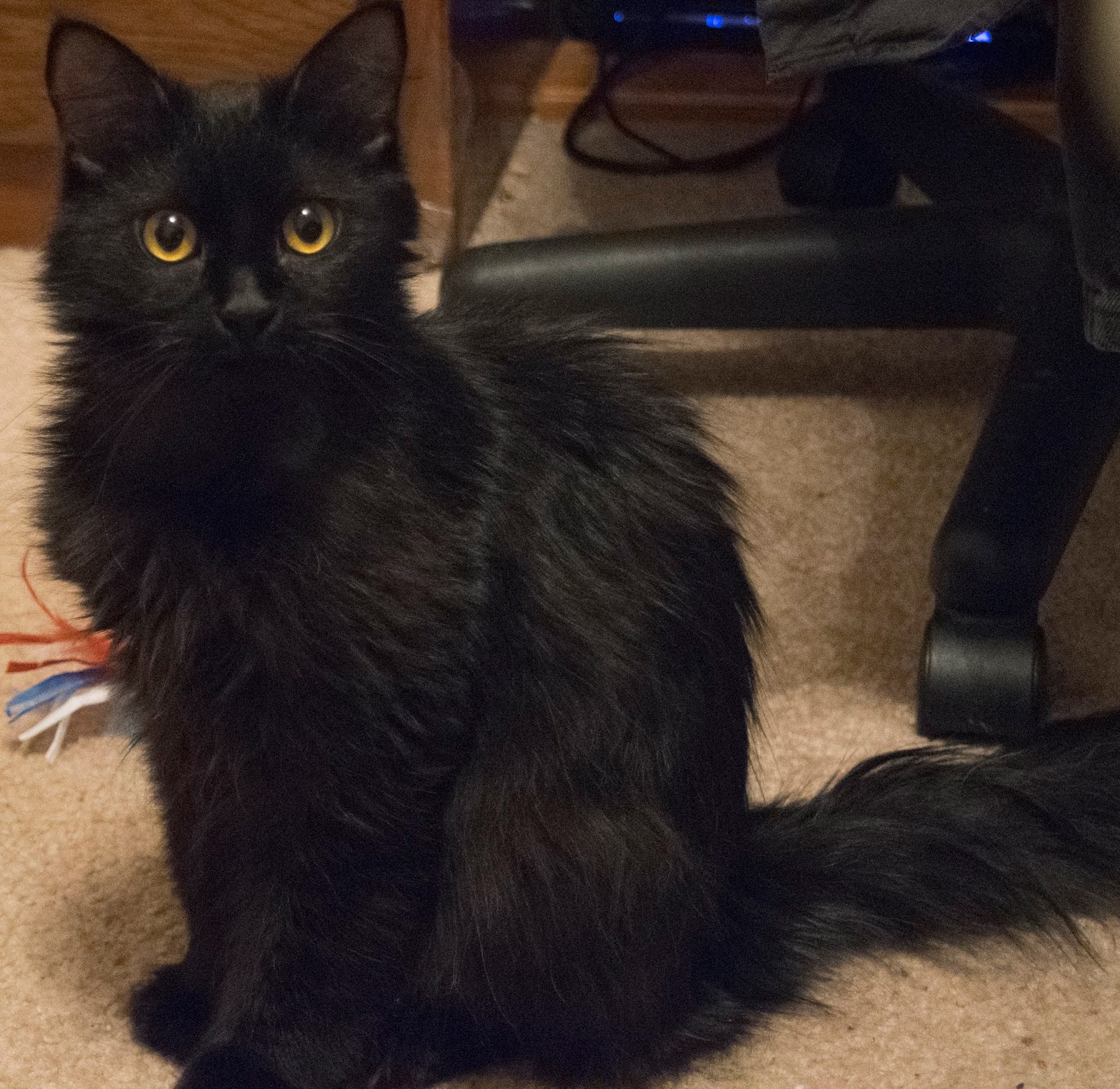
Knowing that the best way to honor their loss would be to rescue another cat, I went to Pets and People and found Marlowe, who is the inspiration for INK. Marlowe was a special project cat, being feral and cringing when anyone attempted to pet him made his chances for his adoption slim. But his orange eyes did me in. Now Marlowe is not only spoiled and loves to be petted, he follows me everywhere, kind of like the puppy I never had.
Marlowe, under a year old.


Last September I decided to retire, you see cancer changed me in a lot of ways and one of those ways was not wasting away at a call center job even though it paid extremely well. My life had returned to a cycle that I could not break. Go to work at a highly stressful job, go home, sleep, repeat. I decided to give my creative outlet its voice and return to what I love doing since I really don't know how long I have left to tread this sodden earth. I don't live in the daily fear of cancer returning, don't get me wrong, but I wanted to take the lessons I learned from cancer and make the most of what time I have left. So INK was brought from creative aspirations to paper.

I also wanted to take the opportunity to pay homage to the felines that I have known in my life as well as bring characters that have haunted me for decades and create a world that appealed to me that they could play in and I, myself could get lost in. INK is entirely a vanity project. It takes longer for me to do a page, since I am not relying solely on pencils and digital means to create it, but old school tactics, pen and ink. But in this I am trying to do quality over volume. I started in September and now only have 5 pages done with page 6 near completion. As soon as I sort some other things out in my life, progress may go a lot faster.

Banner for INK

  If you choose to support INK, you can do so in different ways. Either buying a Tee Shirt that has my original art reproduced on it or by subscribing to my Patreon account. Even if you don't choose to support it, I am am hoping you will enjoy it anyway...and at least give it a nod and maybe some attention that you will pass along.

Tuesday, January 7, 2020

Artist of the Month for January

I was sitting here this morning trying to work out marketing strategies, preferably I would rather put a pencil in my eye. So I decided to detach, let go so to speak. I always feel as though I am whoring a bit when I push my work. I guess I am old school, the work should speak for itself, but in this digital age that simply is not the case. So I return to what one of my original themes of this blog site is, Artist of the Month.

Now not all Artists of the Month have to be artists I have met and I have never met Barry Windsor-Smith. I always wanted to. I have read several of his interviews, own Opus 2, have a copy of the Studio and collected (which sadly are gone and now all I have are reprints) his Conan comics that he drew for Marvel. I have always wanted to meet him, show him the body of some of my work and tell him, "Here, you are responsible for this." Maybe it is better I didn't meet him, if he rejected my work my inner child would suicide on the spot.


I am choosing Barry Windsor-Smith for Artist of the month for a few reasons. One is that it is January, the start of a new year and also coincides with Machine Man which takes place in 2020. A title Barry worked on.

The other is that Barry Windsor-Smith inspired me like no other artist, not just by his style, but by watching his grow. This growth I witnessed from his early Conans to his work in the Studio and beyond convinced me that one can get better with dedication. Barry Windsor-Smith is the heart of dedication. I can think of no other artist that with determination and belief blossomed as much as he. He also introduced me to the Pre-Raphaelites, which broadened my artistic vision. Watching Barry grow made me believe I could too.

There are the stories of how he sent work to Stan Lee and Lee invited him to come to Marvel, which he did all the way from England and ended up drawing his first strips on park benches in New York. Can you think of the determination it took to do something like that?
Frost Giant's Daugher


I first noticed Barry's work in Conan 1, which was unique but his style was in its infancy and you could see that this was someone trying very hard to define his mark. Then came out one of my all times faves, "The Tower of the Elephant". Barry showed that he was developing his own sense of graphic narrative. One of the pages had no word balloons using only panels to tell the scene. To me, it was magic. Then by issue  # 8, the "Frost Giant's Daughter"inwardly I knew Barry was the man to watch. That was in 1970.

Tower of the Elephant
In 1973, Barry did "Red Nails", in a black and white format and also "Song of Red Sonja" which was his last work on Conan. The disappointment in his leaving the series for me personally caused me to drop the Conan titles all together. The replace- ment artists just didn't seem to capture the fantastic as Barry had done. I moved on. The magic had simply gone.

Red Nails


During this era Barry formed Gorblimey Press and began selling prints of his work and then in 1979 he joined Jeffrey (Catherine) Jones, Bernie Wrightson and Micheal Wm Kaluta and created the Studio. Four comic book artists that showed the art world that comic book art should be taken more seriously. This was later vindicated when Barry's Artemis & Apollo sold for $ 75,000 and Bernie Wrightson's illustration for Frankenstein auctioned off for over a million just last year.


Artemis and Apollo

The Studio fired my imagination. Barry's work had opened up a new world for me in the fantastic. All four artists tripped my imagination and fired my desire to create. But behind it all I could see Barry smiling, whispering "take what we do seriously."


Barry's logo for the Studio

Bernie Wrightson, Jeff Jones, Michael Wm Kaluta and Barry Windsor Smith

Stan Lee never though Conan would take off. He came close to shutting it down, thought it was a pretty book but would go nowhere. I won't delve into the friction at Marvel that developed between them and Barry. A lot of it is gossip. Barry did continue to do work for Marvel off and on. He wrote and drew the Weapon X backstory and also started his own series for another label, Valiant Comics, Armstrong and Archer and the Story Teller series.

Barry disappeared from the scene for sometime. Apparently he has been working on a new graphic novel entitled Monsters. It is reported to be over 300 pages. Who the publisher is and the publication date is yet to be revealed...but I am anxiously waiting.

Thank you Barry, for your inspiration.